22-10-26
LED video walls have become an important part of modern
business environments. They help businesses communicate messages, present
information and create engaging visual experiences. However, choosing the right
display involves more than checking its size and brightness. Factors such as
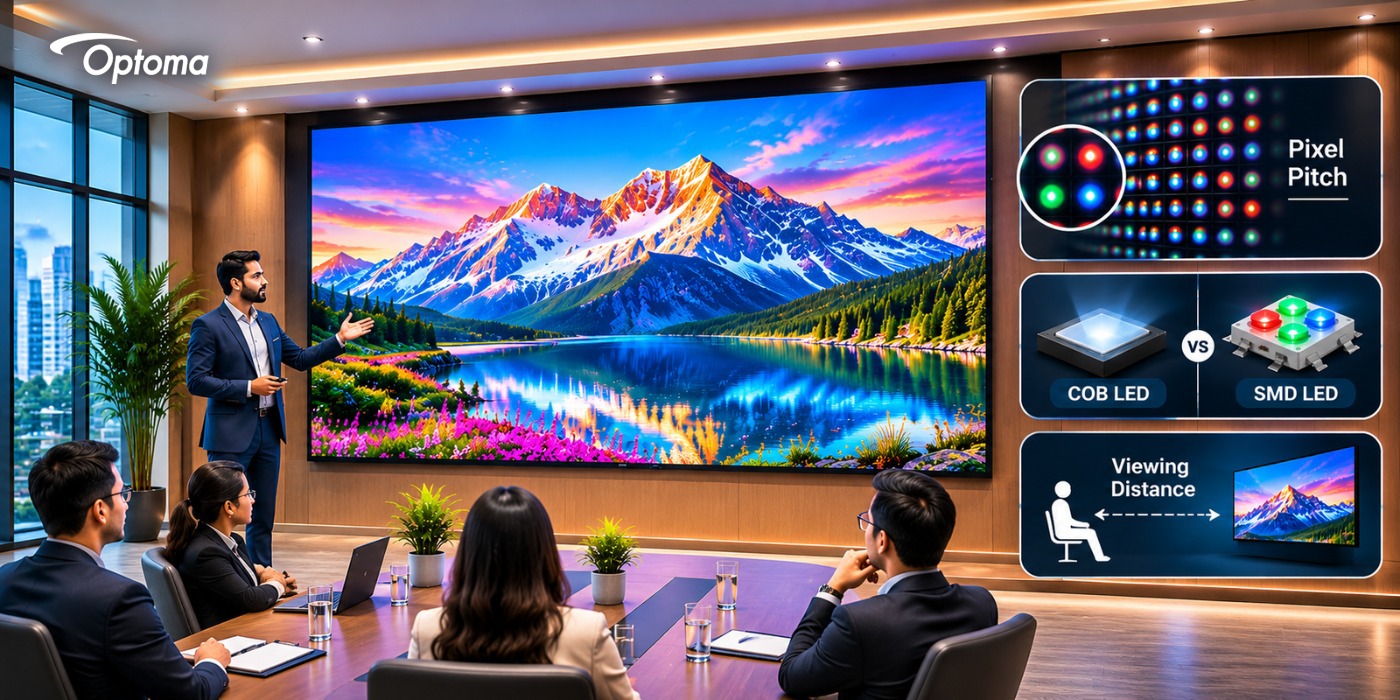
pixel pitch, LED technology and viewing distance play an important role in the
decision.
An LED screen display board can serve different purposes in
corporate offices, retail spaces, hospitality venues and experience centres.
Optoma India offers professional display solutions through its ProScene
All-in-One Direct View LED displays, which combine large-format visuals with
integrated features and practical installation benefits. Here are the key
factors to consider before choosing an LED video wall.
1.
Understanding Pixel Pitch in an LED Video Wall
Pixel pitch refers to the distance between the centres of
two neighbouring pixels, measured in millimetres. It determines how closely
pixels are placed together and influences the sharpness of the displayed image,
especially when viewed from a short distance.
A smaller pixel pitch places pixels closer together, making
it suitable for applications where viewers sit or stand near the screen. A
larger pixel pitch can work well in spaces where viewers are positioned farther
away.
When selecting an LED screen display board, consider the
screen size, viewing distance and type of content being displayed. Meeting
rooms, for example, often require clear text, spreadsheets and presentation
details.
Optoma's ProScene FHDC135 is a 135-inch Full HD Direct View
LED display with a 1.56 mm pixel pitch. It is an option for professional
environments that require a large display with detailed visuals.
2. COB LED vs
SMD LED: What Is the Difference?
COB (Chip-on-Board) and SMD (Surface-Mounted Device) are two
common technologies used in LED displays. Understanding COB LED vs SMD LED
helps businesses compare display construction, surface protection, maintenance
requirements and suitability for different environments.
|
Feature
|
COB LED
|
SMD LED
|
|
Construction
|
LED chips are mounted directly onto a substrate and
encapsulated.
|
Packaged LED components are mounted onto a circuit board.
|
|
Surface protection
|
Encapsulation helps protect the LED surface against
mechanical impact.
|
Individual LED packages may be more exposed, depending on
the design.
|
|
Close viewing
|
Well suited to fine-pitch applications requiring close
viewing.
|
Performance depends on pixel pitch and display design.
|
|
Maintenance
|
Often uses modular tiles or panels for servicing.
|
Individual components may be replaceable, depending on the
design.
|
|
Applications
|
Suitable for professional installations requiring a
protected display surface.
|
Used across a wide range of indoor and outdoor display
applications.
|
In the case of COB LED vs SMD
LED, companies need to look at the environmental conditions during
installation, viewing distance, and maintenance needs and costs. Both
technologies are not suitable for every situation by default.
The Optoma ProScene All-in-One LED display employs Flip Chip COB
technology. This technology has its LED surface encapsulated and is resistant
to any physical impacts; moreover, it can ensure efficient cooling.
For an indoor SMD screen to be
installed indoors, one needs to look at these qualities in relation to the
specific needs of their installation.
3. How to
Choose the Right Viewing Distance
Viewing distance is closely related to pixel pitch. If
viewers stand too close to a display with a larger pixel pitch, individual
pixels may become noticeable, affecting the viewing experience.
Here are some general considerations when selecting LED wall
panels for different spaces:
- Meeting
rooms: Prioritise readable text, spreadsheets and presentation
details.
- Corporate
lobbies: Consider how far visitors will stand from the display.
- Retail
spaces: Select pixel pitch based on customer viewing distance and
content requirements.
- Auditoriums
and large venues: Consider screen dimensions, audience seating and
visibility from the farthest seats.
These are general guidelines rather than fixed rules. Always
check the manufacturer's recommended viewing distance for the selected model.
For example, the Optoma ProScene
FHDC135 requires a minimum viewing distance of 3.2 metres. This
specification should be considered when planning the display's placement and
the available viewing area.
Before installing LED wall panels, assess the room layout,
audience position and type of content to ensure the display is suitable for the
space.
4. What Else
Should You Check Before Buying?
Pixel pitch and LED technology are essential, but there are
other parameters that determine the quality and efficiency of an LED video
wall.
Brightness: Consider the lighting in the space where
the installation is being done to ensure the clarity of the display in these
lighting conditions.
Resolution and color: Consider how effectively the
screen delivers text, images, videos and other visual information.
Installation: Assess available wall space, mounting
possibilities, cabling, and electricity needs.
Maintenance: Determine the availability of
components, replacement processes, and services.
Content management: Consider how content will be
distributed, scheduled, and updated on the display.
Refresh rate: Consider the capability of the display
to play visual information without lagging.
Optoma ProScene FHDC135 comes with 700 nits brightness, a
3,840 Hz refresh rate, built-in Android, Display Share, and Optoma Management
Suite Cloud. These features make the display capable of handling professional
presentations, content distribution and management in appropriate
installations.
While choosing an LED screen display board, businesses have
to think of how easy integration would be.
5. Where Can
Optoma LED Displays Be Used?
LED display solutions have
wide-ranging applications from corporate offices to retail, hospitality venues,
museums, and experience centers. Such displays can show business data,
advertising, communication messages, and large scale visual presentations.
The Optoma ProScene All-in-One
LED Series integrates display capabilities, audio, and smart solutions in one
package. The pre-assembled columns and front accessible tiles make the
installation and service process easier.
When choosing between the
indoor SMD screen or the COB displays for a company, it is important to pay
attention to the environment in which the screen will be installed. Such
aspects as ambient lighting, viewing distance, screen protection and accessibility
of the screen will affect the final decision.
Likewise, when evaluating
various LED wall panels, it is necessary to look beyond the size of the screen
and consider the installation requirements.
A LED video wall must
correspond to the space available, to viewing conditions, and to the daily
necessities of a business. Properly chosen technology can help achieve an
optimal compromise in terms of image quality, usability, and maintenance.
Conclusion
To select an LED video wall, one has to begin by
understanding pixel pitch, COB and SMD technology, viewing distance, and
installation requirements. Understanding all these factors allows companies to
determine which display will be ideal for their environment and purpose.
If you are considering COB LED vs. SMD LED, analyzing a
indoor SMD screen or choosing a LED display panel for your corporation, it is
crucial to understand the entire application process and not just a single
parameter.
ProScene All-in-One LED displays from Optoma represent some
of the best options when it comes to professional visuals that offer big
picture as well as additional features and easy installation. Check out the LED
display selection of Optoma.